
A Beginner's Guide to Mindfulness-Based Stress Reduction
Maybe it's the back pain that comes and goes without a clear reason. The night you couldn't sleep even though nothing particularly terrible happened that day. The way a certain conversation leaves you tense for hours, and you're not even sure why. The feeling of something being off, that you can't really pin-point.
None of that looks like a crisis. And so most of us don't treat it like one.
We attribute it to a busy week, a bad night, getting older, just life, and we keep moving. Sometimes the signals get a little louder, or we get a little better at ignoring them - many times it’s both.
MBSR didn't start out for people like that. It actually started for people in serious, undeniable pain. But somewhere along the way, something has become clear: the suffering that brings people to this practice isn’t always extreme. Sometimes it's quiet or even not yet identified. Sometimes it's been there so long you've even stopped noticing it.
What is MBSR?
(And why does the name undersell it?)
MBSR stands for Mindfulness-Based Stress Reduction. And I actually believe that the name is doing this practice a bit of a disservice.
"Stress reduction" makes it sound like a coping tool. Something you reach for when work gets overwhelming or your nervous system is fried. And yes, that might be a reason many people join the course. But if you come to MBSR only looking for stress relief, you'll leave with something much bigger and probably not what you expected.
MBSR was developed in 1979 by Jon Kabat-Zinn, a molecular biologist at the University of Massachusetts Medical School. He'd been a longtime meditation practitioner and started noticing something in his clinical work: how patients related to their pain seemed to matter as much (or even more?) as the treatment itself. He created a secular, scientifically grounded secular version of mindfulness practice, rigorous enough to study, and accessible to people who had never meditated in their lives.
It was originally designed for people with chronic pain and serious medical conditions. People who were, in very concrete ways, suffering. And it worked. But over time, both the people teaching it and the people taking it started noticing something: this wasn't only helping with the extreme cases. It was touching something far more universal.
The Buddha wrote about this a long time ago, and without trying to be reductionist of his teachings, one of his messages was: suffering and pain are part of being human. Not in a pessimistic way, but as an honest one. A heartbreak. A repeating pattern in your relationships. A health diagnosis. A life transition that looks like success from the outside. Grief. The exhaustion of a role you chose and still find overwhelming. Motherhood. None of these necessarily read as "stress reduction" territory. But they can all be sources of pain and challenges.
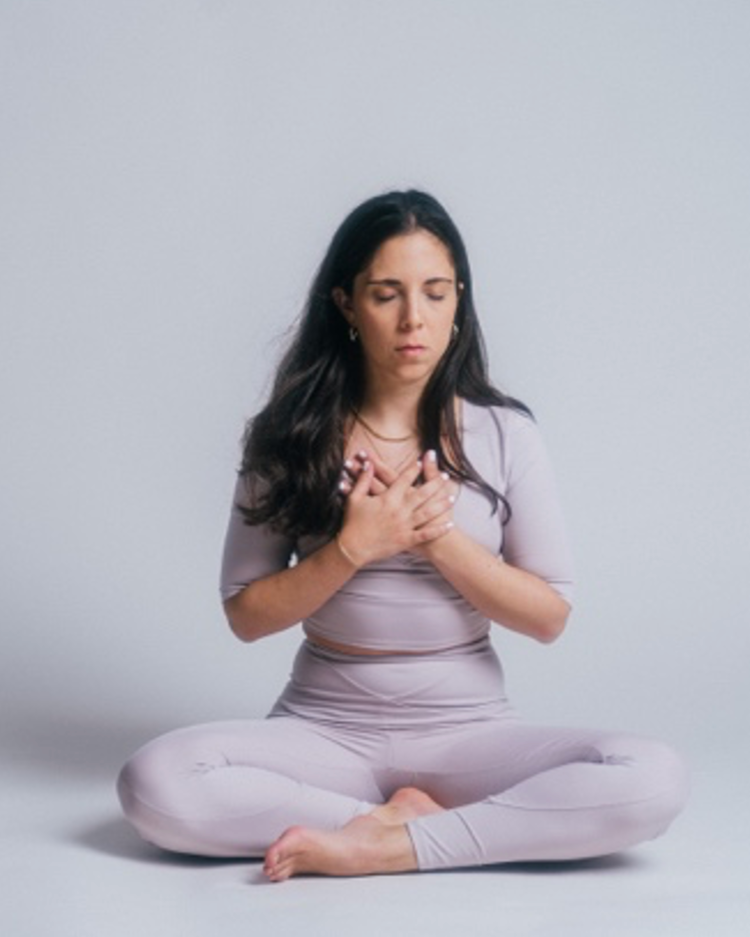
“Between stimulus and response there is a space. In that space is our power to choose our response. In our response lies our growth and our freedom.”
-Viktor Frankl
MBSR was built, at its core, to teach you to notice the moment something happening, whether externally or internally, causes tension in you. And how, by just noticing it and pausing, you create something: a moment to respond to that input in a different way.
Decades of research have followed Kabat-Zinn's original work and MBSR is now one of the most studied psychological interventions in existence.
What Happens in an MBSR Program?
MBSR unfolds over 8 weekly sessions of approximately 2.5 hours each, plus a half-day retreat near the end of the program and daily home practice of 40–45 minutes between sessions.
Each week builds on the last, moving from the foundations of body awareness into increasingly nuanced territory:
Week 1 — Automatic pilot: noticing how much of your life you're living on autopilot. Most people find this more uncomfortable than they expected.
Week 2 — Perception and creative responding: how the story you tell about a difficult moment shapes how difficult it actually feels.
Week 3 — Being present in the body: deepening physical awareness through movement and the body scan.
Week 4 — Stress & responding vs. reacting: understanding the stress cycle and developing the capacity to pause before reacting.
Week 5 — Difficult emotions: turning toward uncomfortable feelings with steadiness rather than suppression.
Week 6 — Mindful communication: relationships and communication are usually one of the greatest cause of tension in our lives.
Week 7 — How can I best take care of myself?: identifying what genuinely nourishes, what depletes, and what is purely coping.
Week 8 — Using what you've learned: integrating the practice into daily life beyond the course. The beginning of a practice that’s actually yours.
The core practices taught throughout the program include:
The Body Scan — a lying-down practice of moving attention systematically through the body
Mindful movement — gentle yoga movements practiced with full awareness
Sitting meditation — working with breath, body sensations, sounds, thoughts, and emotions
Walking meditation — bringing mindfulness into motion
Real talk: the home practice is a real commitment. About 40 minutes a day, six days a week. This is not a passive experience where something happens to you. It works because you work with it.
What the Research Says
Completing the 8-week program has been consistently associated with meaningful reductions in perceived stress, anxiety, and symptoms of depression. Studies have documented decreases in emotional reactivity and rumination, physical symptom relief in people with chronic pain, cancer, and heart disease, and measurable changes in brain structure after just eight weeks. Specifically, increased density in regions associated with attention, emotional regulation, and self-awareness.
The brain literally changes by practicing practicing mindfulness, repeatedly, over time.
If you want to go deeper into the evidence, Jon Kabat-Zinn's book Full Catastrophe Living is the most comprehensive starting point.
MBSR vs. MBCL: Which One Is Right for You?
They're companion programs, not competing ones.
MBSR is the foundation. It teaches you to notice what's actually happening in your inner life, rather than living at the mercy of it. No meditation experience required.
MBCL, Mindfulness-Based Compassionate Living, picks up where MBSR leaves off. Once you've developed the capacity to be present with your experience, MBCL asks a different question: can you meet it with kindness? Its focus is self-compassion, the quality of warmth toward yourself specifically in moments of pain and difficulty.
A lot of people find that MBSR opens a door they didn't know was there. MBCL is about learning to walk through it without being so hard on yourself.
You can read the full comparison here: What Is MBCL? A Beginner's Guide to Mindfulness-Based Compassionate Living
Who Is MBSR For?
MBSR is for you if:
You are living under chronic stress — from work, relationships, health, or the accumulated pressure of high expectations
You feel like you're always reacting — snapping, shutting down, lying awake — and want more capacity to choose your response
You've tried to meditate before and couldn't stick with it, and want a structured program that builds the practice week by week
You experience anxiety, burnout, insomnia, or physical tension that feels rooted in how you're holding your life
You want something evidence-based — not spiritual bypassing, not wellness aesthetics, but a method with four decades of rigorous research behind it
You are new to mindfulness, or want to go back to the fundamentals with proper guidance
There is no ideal candidate for MBSR. It was originally designed for people with chronic pain and medical conditions — and it works equally well for people who are physically healthy but emotionally depleted. The program meets you exactly where you are.
What to Expect in an Online MBSR Course
Live online MBSR makes the program accessible wherever you are — without giving up the relational quality that makes group practice work.
In my live online MBSR course via Zoom, you will find:
8 weekly live sessions (approximately 2.5 hours each) in a small, intentional group
Guided meditation audio recordings for your daily home practice between sessions
Gentle movement practices adapted from trauma-sensitive yoga — I bring my training as a trauma-sensitive yoga teacher into every session
Teaching in English, Spanish or German.
Not sure if you're ready to commit to 8 weeks yet?
Start smaller. I have a free guided meditation on Insight Timer — no account needed, no obligation. It will give you a direct experience of the practice before you decide anything.
→ Listen free on Insight Timer
Ready to begin?
The next live MBSR course is open for enrollment. Spaces are intentionally limited.
→ See dates and enroll in the MBSR Online Course
About the author: I'm Paulina, founder of Aha Moments and MBSR and MBCL teacher. I work with women who are highly functional on the outside and struggling on the inside — helping them come home to their bodies and their lives through evidence-based, somatic mindfulness practice. I teach live online and in-person in Germany, in English, Spanish and German.